1752119111@qq.com
+86 1365 2921 391
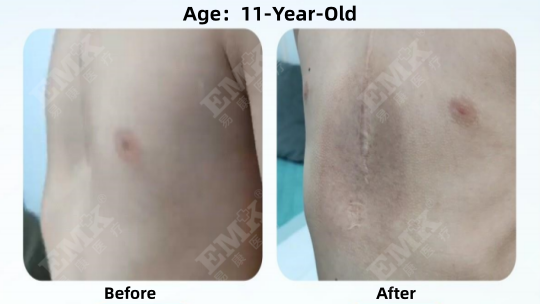
While Pectus Excavatum is commonly considered a congenital chest wall deformity, some patients may develop a chest wall depression following cardiac surgery performed during infancy or childhood.
Children who undergo median sternotomy for congenital heart disease repair may experience changes in chest wall growth over time. In some cases, this can result in acquired pectus excavatum.
This case documents an 11-year-old patient with post-cardiac surgery pectus excavatum managed with Vacuum Bell therapy.
11 years old
July 2024
Previous congenital heart surgery
History of median sternotomy
Progressive chest wall depression during growth
Central sternal depression
Depression around the surgical scar area
Uneven anterior chest wall contour
Visible chest wall deformity
Acquired pectus excavatum refers to chest wall depression that develops after surgery or other chest wall changes rather than being present as a primary congenital deformity.
Potential contributing factors may include:
Sternotomy healing patterns
Chest wall growth changes
Costal cartilage development
Structural changes after surgery
Vacuum Bell Therapy
Non-surgical chest wall management
Improve chest appearance
Reduce visible depression
Improve chest symmetry
Support chest wall management
A noticeable depression was observed in the central sternum and previous surgical area.
The chest wall contour appeared uneven.
Compared with baseline:
Changes in chest wall appearance were observed
Reduced visibility of the depressed area
Smoother sternal contour
Improved chest symmetry
Based on image comparison:
Changes in chest wall appearance were observed.
The chest wall contour appeared smoother.
Improved balance between both sides of the chest.
The chest shape appeared closer to a natural chest wall contour.
Management planning should consider:
Type of cardiac surgery
Sternum healing status
Cardiac history
Chest wall development
Professional clinical evaluation
No. Only a subset of patients experience chest wall depression during growth.
Acquired pectus excavatum develops after surgery or chest wall changes, while congenital pectus excavatum is present due to developmental factors.
Suitability should be determined through individualized clinical evaluation and review of surgical history.
This case is presented for educational purposes only. Individual outcomes vary depending on anatomy, surgical history, growth patterns, and treatment response.
EMK Yikang Medical provides:
✓ Post-Surgical Chest Wall Evaluation
✓ CT Imaging Analysis
✓ 3D Chest Wall Reconstruction
✓ Customized Design Based on CT or 3D Modeling
✓ Long-Term Follow-Up Support
Contact our team for a personalized assessment.
Contact: KAM
Phone: +86 1365 2921 391
Tel: +86 1365 2921 391
Email: 1752119111@qq.com
Add: Orthosis Customization Center, 6th Floor, Rehabilitation Building, Guangdong Maternal and Child Health Hospital
We chat