1752119111@qq.com
+86 1365 2921 391
Pectus Carinatum, commonly known as pigeon chest, presents differently in every patient. The degree of chest protrusion, chest wall flexibility, age, and growth stage can all influence treatment planning and outcomes.
This page presents selected examples of chest wall management and brace treatment follow-up, helping patients and families better understand how Pectus Carinatum may change over time with appropriate treatment and monitoring.
The cases presented on this page are based on chest wall assessment and long-term follow-up records collected through EMK Medical's chest wall management programs.
Case documentation may include:
Initial clinical evaluations
CT imaging analysis
3D chest wall reconstruction
Brace treatment follow-up records
Standardized photographic documentation
Patient and family feedback
Long-term monitoring data
To improve consistency, photographs are taken under similar conditions whenever possible, including posture, camera angle, and lighting.
Because chest wall flexibility changes with age, treatment outcomes may vary among different patient groups.
Cases on this page are organized into three age categories:
The chest wall is generally more flexible and continues to develop.
This is the most common age group for Pectus Carinatum Treatment.
Chest wall structures are more mature, and treatment plans often require individualized evaluation.
The majority of patients featured on this page received one or both of the following management approaches.
Brace treatment is one of the most widely used non-surgical options for Pectus Carinatum.
The brace applies controlled external pressure to the protruding area of the chest, gradually encouraging chest wall remodeling over time.
Potential benefits include:
Reduction of sternum protrusion
Improved chest symmetry
Better overall chest contour
Non-surgical management approach
Some patients may also participate in:
Posture correction programs
Breathing exercises
Core strengthening
Chest wall mobility training
Physical activity guidance
Combined approaches are often recommended during growth periods to support overall chest wall development.
Treatment outcomes are assessed using multiple methods to provide a more objective evaluation.
Photos are typically taken from:
Assessment of chest prominence and symmetry.
Evaluation of sternum projection.
Visualization of chest wall contour.
Photographs are obtained under similar conditions whenever possible.
Clinical assessments may include:
Degree of chest protrusion
Chest wall symmetry
Rib flare evaluation
Changes in chest contour over time
Follow-up intervals commonly include:
Initial assessment
3 months
6 months
12 months
18 months or longer
Some patients continue follow-up beyond two years.
Children often demonstrate the highest chest wall flexibility, making early evaluation particularly valuable.
5 years old
Mild to Moderate
Custom Brace Therapy
Regular Follow-Up
8 Months
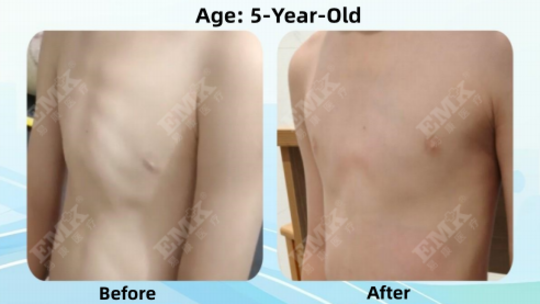
Reduced chest protrusion
Improved chest contour
Better chest symmetry
Increased family satisfaction with appearance
10 years old
Mild
Brace Therapy
Posture Training
12 Months
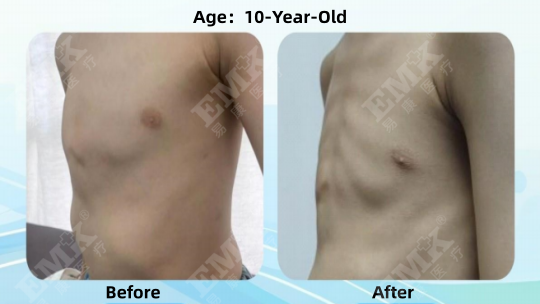
Noticeable reduction in sternum prominence
Improved body posture
Better chest wall balance
Adolescents represent the largest treatment group for Pectus Carinatum.
Because growth is still occurring, chest wall remodeling potential may remain significant.
12 years old
Mild
Brace Therapy
Comprehensive Exercise Program
10 Months
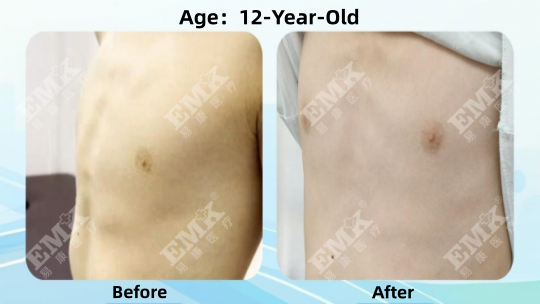
Visible improvement in chest shape
Reduced protrusion
Improved confidence
14 years old
Mild
Long-Term Brace Therapy
18 Months
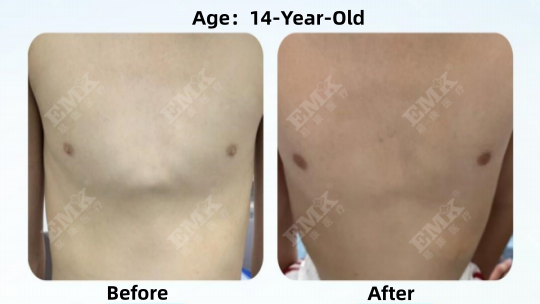
Improved chest wall contour
Reduced rib flare appearance
Better overall chest symmetry
Every patient responds differently to treatment.
Factors that may influence outcomes include:
Age
Chest wall flexibility
Severity of protrusion
Treatment compliance
Daily brace wearing time
Growth stage
Rib flare severity
Overall chest wall anatomy
In general:
Children → Adolescents → Adults
Younger patients often have greater chest wall remodeling potential.
The cases shown on this page are provided for educational and informational purposes only.
Individual treatment responses vary significantly.
The outcomes shown do not guarantee similar results for every patient.
A professional chest wall evaluation is necessary to determine whether brace treatment may be appropriate for a specific individual.
Some patients may notice visible improvements within several months, while others may require longer treatment periods depending on age, chest wall flexibility, and severity.
Selected adults with sufficient chest wall flexibility may still experience improvement, although treatment often requires longer durations than in younger patients.
No.
Treatment outcomes vary depending on individual anatomy, compliance, growth stage, and chest wall characteristics.
Long-term stability depends on multiple factors, including age, skeletal maturity, treatment completion, and follow-up management.
Every chest wall is different.
A comprehensive evaluation may help determine:
Whether brace treatment is appropriate
Expected improvement potential
Recommended treatment duration
Individualized management strategies
EMK Yikang Medical provides:
· Professional Chest Wall Evaluation
·CT Imaging Analysis
· 3D Chest Wall Reconstruction
·Custom Brace Design Based on CT and 3D Modeling
· Long-Term Follow-Up Support
·Personalized Treatment Recommendations
Contact Our Team Today for a Professional Assessment and Treatment Consultation.
Contact: KAM
Phone: +86 1365 2921 391
Tel: +86 1365 2921 391
Email: 1752119111@qq.com
Add: Orthosis Customization Center, 6th Floor, Rehabilitation Building, Guangdong Maternal and Child Health Hospital
We chat